How to Measure Kitchen Cabinet Doors Accurately
Are you tired of struggling to get the perfect fit for your kitchen cabinet doors? You’re not alone—many people find measuring cabinets tricky, leading to costly mistakes or delays. Getting it right is essential for a smooth, professional look that you’ll love.
To measure your kitchen cabinet doors accurately, gather essential tools like a tape measure, level, and notepad. Measure width and height at multiple points—top, middle, bottom—using precise, calibrated tools.
Don’t forget to note hinge placement, hardware, and overhangs for a perfect fit. Double-check all measurements to catch errors.
If you want step-by-step guidance and tips for matching hardware and handling discrepancies, keep exploring these helpful strategies.
Key Takeaways
- Measure width and height at multiple points—top, middle, and bottom—to catch any irregularities.
- Record measurements immediately, noting the location, and double-check for accuracy.
- Use a level and calibrated tools to ensure your measurements are precise and straight.
- Don’t forget to measure hinge placement, handle spacing, and overhang to get the hardware fitting just right.
- Communicate your measurements clearly with detailed sketches, and double-check everything before placing your order.
Gather the Right Tools to Measure Kitchen Cabinet Doors
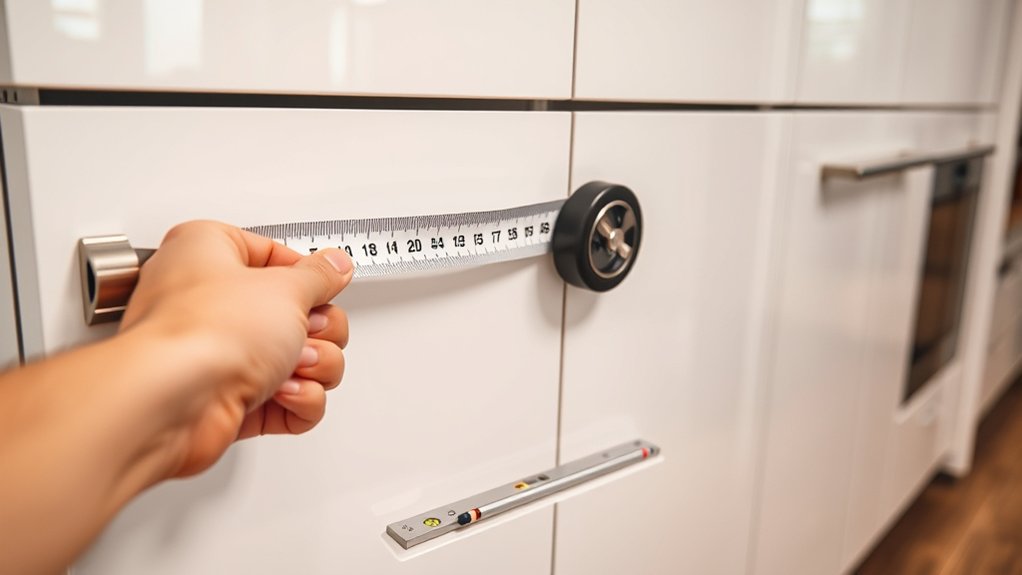
Before you start measuring your kitchen cabinet doors, it’s essential to gather the right tools. A tape measure is your main tool to ensure accurate dimensions. Keep a pencil and notepad nearby to jot down measurements as you go.
Gather essential tools like a tape measure, pencil, and notepad for precise kitchen cabinet measurements.
If you’re planning to replace or add decorative accents, take time to measure your current hardware or trim. This helps you match style and material choices perfectly. A level can help confirm that doors hang straight, especially if you’re adjusting hinges.
Having a ruler or small square is also helpful for checking corners and edges for precise measurements. When choosing decorative accents, think about how materials like wood, glass, or metal will complement your cabinet style.
Gathering these tools beforehand saves time and makes sure your measurements are spot on. Being prepared with the right tools helps you measure confidently, leading to a successful upgrade or replacement.
How to Measure Your Kitchen Cabinet Doors Accurately
To measure your kitchen cabinet doors accurately, start by removing the doors from their hinges if possible. Lay them flat on a protected surface to ensure precise measurements.
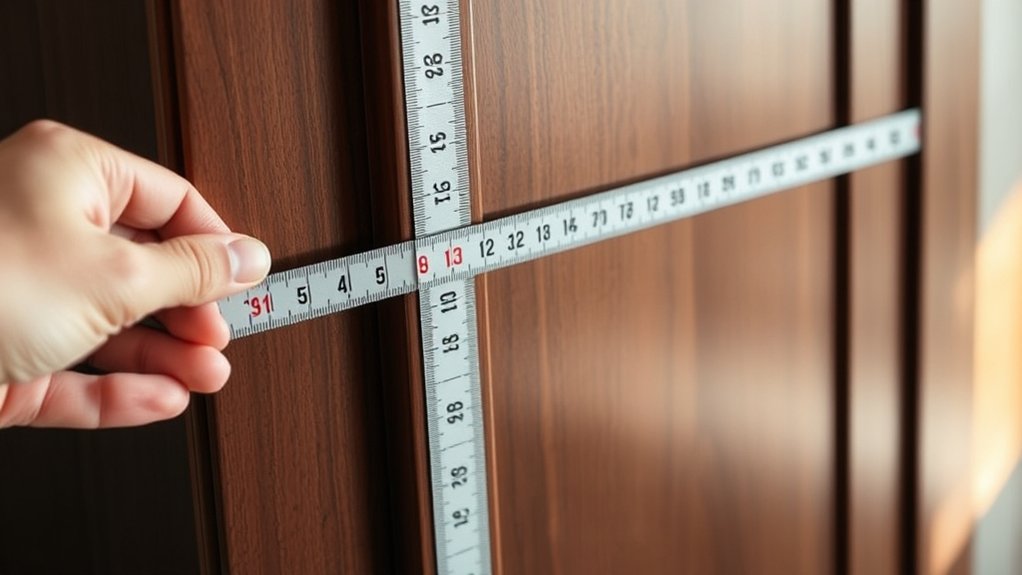
Use a tape measure to record the width and height, measuring at the widest and tallest points. Be sure to measure from edge to edge for the most accurate size, especially if your doors aren’t perfectly square.
Keep in mind your cabinet color and kitchen layout when choosing new doors, as these affect the overall look. If your kitchen has an open layout or unique colors, measure carefully to match existing elements or create a cohesive style.
Take multiple measurements to confirm consistency, especially if the doors have any warping or irregularities. Accurate measurements will help your new cabinet doors fit seamlessly, boosting your kitchen’s style and functionality.
Accounting for Hinges, Handles, and Overhangs When Measuring
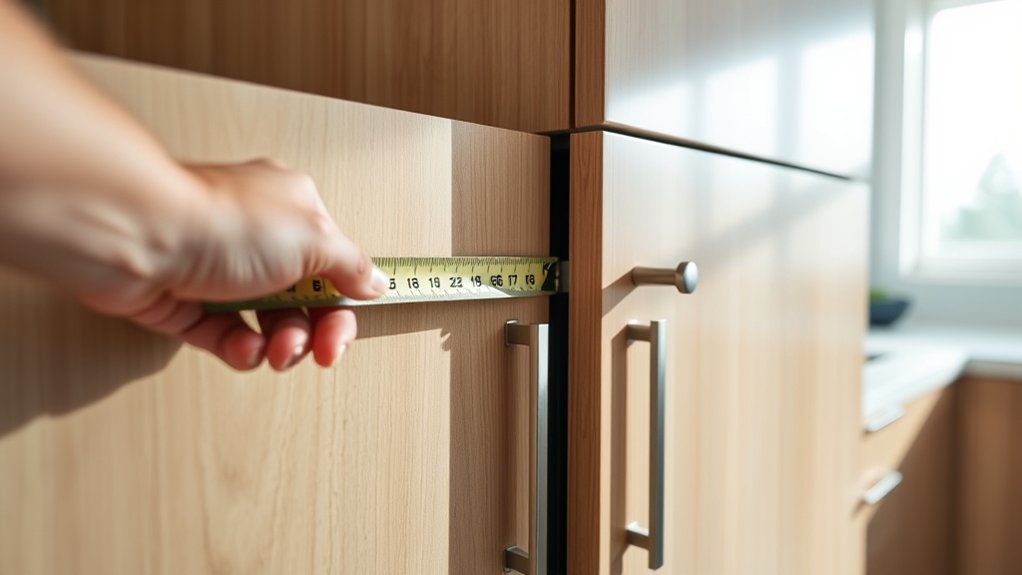
When measuring your cabinet doors, it’s important to consider hinges, handles, and overhangs because these features can affect how everything fits and looks. Hinge placement determines how far the door sticks out from the cabinet frame, so measure from the door edge to where the hinges will go.
Handle spacing is key for both function and style. Make sure handles are placed consistently, usually about 2.5 to 3 inches from the edge. Overhangs, which are the parts of the door that extend beyond the frame, impact clearance and appearance, so measure the overhang carefully for a balanced look.
| Feature | Measurement Tip |
|---|---|
| Hinge placement | Measure from the door edge to the hinge mounting point. |
| Handle spacing | Keep handles 2.5–3 inches from the edge for uniformity. |
| Overhang | Measure how far the door extends beyond the frame. |
| Hinge type | Different hinges may need different clearances. |
| Handle height | Keep handles at a consistent height for a cohesive look. |
Measuring Width and Height: Step-by-Step Guide
To get accurate measurements, you’ll want to start with the right tools—think a tape measure and a pencil. Having these on hand makes the process much easier and helps you get precise results.
Next, when you’re measuring the width and height, don’t just do it once. Take measurements at several different points along each dimension. This way, you can catch any irregularities and ensure your measurements are spot-on.
And remember, it’s a good idea to write down each measurement clearly before you move on to the next step. That way, everything’s organized and you won’t forget any details later on.
Gather Accurate Tools
Before measuring your cabinet doors, you need to gather the right tools to guarantee accuracy. A good quality tape measure is essential for precise measurements of width and height.
Keep a pencil and a notepad handy to record your measurements clearly. A spirit level can help verify your measurements are straight, especially if your cabinets have decorative accents or unique styles that require exact fitting.
If your cabinets have intricate details, consider using a ruler or a measuring square for more detailed measurements. Having these tools ready saves time and reduces errors, making sure your measurements are accurate.
Proper tools help you match the cabinet styles perfectly, whether you’re replacing doors or customizing new ones.
Measure Multiple Points
Measuring multiple points guarantees you get the most accurate dimensions for your cabinet doors. Start by measuring the width at the top, middle, and bottom of each door to account for any warping or unevenness.
Do the same for height, measuring from the top to bottom at the left, center, and right sides. This helps ensure your measurements reflect the true size, which is vital for kitchen design and material choices.
Accurate measurements help you pick doors that fit perfectly and look seamless. Even small discrepancies can impact the overall look and functionality.
Taking multiple measurements captures any irregularities, so you can make informed decisions about your cabinet replacements or upgrades. This step is key for achieving a professional, polished look in your kitchen.
Record Clear Measurements
Once you have your measurements, the next step is to record them clearly and accurately. Use a notebook or a digital tool to jot down each measurement, noting whether it’s width or height.
Be consistent with your units—preferably inches or centimeters—and double-check for accuracy. Precise records are key to proper kitchen design and ensuring your cabinet styles fit perfectly.
Label each measurement with the corresponding door location to avoid confusion later. If you’re measuring multiple cabinet doors, organize your notes systematically.
Clear, accurate measurements help prevent errors during installation or when ordering replacements. Remember, detailed records make your project smoother and help your kitchen look cohesive and well-designed.
Properly recorded measurements are the foundation of successful cabinet fitting.
How to Record and Double-Check Your Measurements
To make sure your measurements are accurate, it’s important to record them carefully and double-check each one. Write down every measurement right after you take it, using a clear and consistent format. This helps prevent mistakes caused by misreading or forgetting details.
When recording, double-check your numbers by comparing them with your original measurements. You can also use calibration techniques, like re-measuring with a different tape or ruler, to confirm they’re correct. Be careful to avoid common errors, such as not holding the tape straight or measuring from the wrong edge.
Always measure multiple times for critical dimensions to ensure consistency. If you notice any discrepancies, re-measure to find and fix the mistake. Accurate recording and double-checking make your measurements reliable, reducing errors that could lead to ill-fitting cabinet doors.
Measuring for Replacement or Custom Kitchen Cabinet Doors
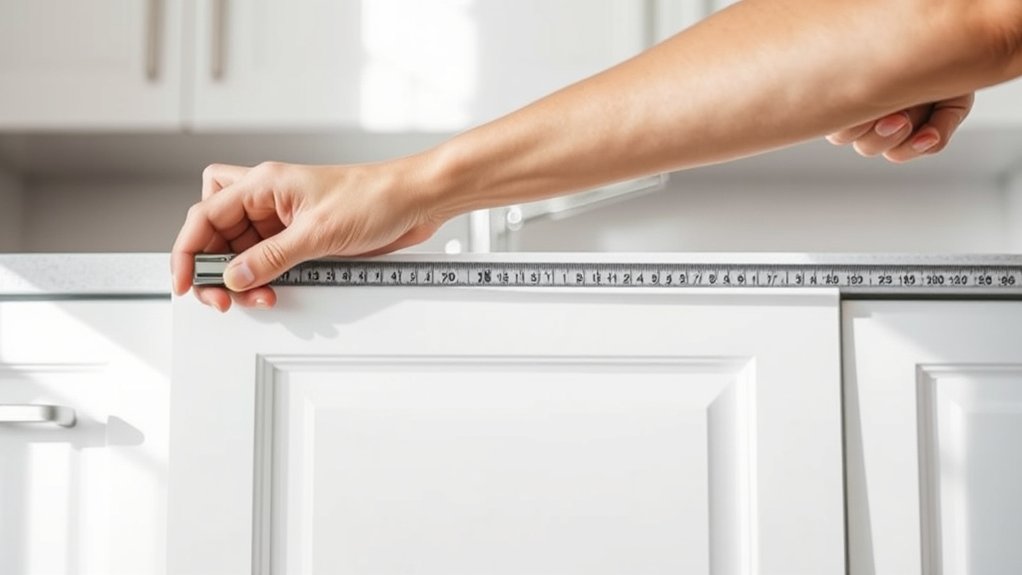
When replacing or customizing kitchen cabinet doors, accurate measurements are key to getting a perfect fit. Whether you’re picking new doors with decorative hardware or matching your existing style, precise measurements make all the difference.
Start by measuring the height, width, and thickness of your current doors or frames. Keep in mind that decorative hardware can affect the size, so don’t forget to account for any knobs or pulls you plan to add.
Here are three simple steps:
- Measure the width and height of the door opening, not just the existing door.
- Record the thickness of your current door to ensure the new one matches correctly.
- Note the style of your cabinets to pick doors that blend seamlessly.
Getting accurate measurements helps you choose custom doors that fit perfectly and look great with the right decorative hardware.
Common Measurement Mistakes and How to Avoid Them
Measuring kitchen cabinet doors accurately can be tricky, and small mistakes can lead to doors that don’t fit or look uneven. One common mistake is rushing through measurements without double-checking, especially with current design trends that favor sleek, seamless cabinets.
Rushing measurements can lead to uneven, ill-fitting cabinet doors—take your time for a perfect fit.
Ignoring the thickness of your chosen material can throw off your measurements, resulting in doors that don’t align properly. Another mistake is measuring only one side or one door, assuming all are identical; always measure multiple points to catch any irregularities or warping.
Additionally, failing to consider hardware placement or overlaps can cause fitting issues. To avoid these pitfalls, take your time, use a reliable tape measure, and note measurements carefully.
Remember that material selection influences the final size, so confirm your measurements reflect the thickness and finish of your chosen materials. Accurate measurements will help ensure your cabinets stay stylish, functional, and perfectly fitted.
Tips for Communicating Your Measurements to Suppliers
Clear communication of your measurements is essential to getting the perfect-fit cabinet doors. When sharing your measurements with suppliers, be precise and clear to avoid mistakes.
First, double-check your measurements before communicating them. Verify all dimensions are accurate and consistent. Second, specify details like the cabinet paint color or finish, as well as your preferred hardware styles, to help suppliers match your aesthetic.
Third, provide a detailed sketch or diagram with labeled measurements, including height, width, and depth. This helps prevent misunderstandings. Use clear language and confirm your specifications verbally or in writing.
Don’t assume suppliers will interpret vague descriptions; clarity is key. Accurate measurements combined with detailed preferences ensure you receive cabinet doors that fit perfectly and match your style.
This minimizes revisions and streamlines the ordering process, saving you time and avoiding unnecessary frustration.
What to Do If Your Measurements Don’t Match or Need Adjustments?
Despite your careful measurements and detailed communication, sometimes discrepancies happen between what you ordered and what arrives. If your cabinet door measurements don’t match, don’t panic.
First, double-check your measurements using measurement calibration techniques to ensure they’re accurate. If you used templates, verify they weren’t damaged or misaligned, as small errors can cause big mismatches.
If discrepancies still persist, contact your supplier right away. They might ask for updated measurements or offer to remake the doors. Fixing measurement errors early can save you from costly adjustments later.
Keep detailed records of your measurements and any correspondence. Remember, precise calibration and reliable templates are key to a perfect fit. Handling issues promptly and accurately will help ensure your cabinet doors fit seamlessly, saving you time and frustration.
Final Tips for a Perfect Fit: Ensuring Accurate Measurements
Before you wrap up your measurements, it’s a good idea to double-check everything. You want to catch any mistakes early on so they don’t cause headaches later. Also, make sure you’re using the right tools—like a level or a tape measure—to get accurate results. When your measurements are spot-on, your cabinet doors will fit perfectly the very first time around.
Double-Check Measurements Carefully
Taking the time to double-check your measurements guarantees your cabinet doors fit perfectly. Avoid measurement pitfalls by reviewing each dimension carefully. Use calibration techniques, like measuring multiple points on each door frame, to verify consistency. Always confirm that your measurements are accurate before moving on.
Here are some key tips:
- Re-measure dimensions at least twice to catch errors.
- Cross-check measurements against your initial plan to spot discrepancies.
- Make sure your measuring tools are calibrated correctly for accuracy.
Double-checking helps prevent errors that could lead to gaps or misalignments. By carefully reviewing each measurement and verifying calibration, you reduce the risk of mistakes. This saves you time and materials in the long run.
Precision at this stage guarantees a perfect fit for your cabinet doors.
Use Proper Measuring Tools
Using the right measuring tools is key to getting accurate dimensions and making sure your cabinet doors fit perfectly. A tape measure is your go-to for precise measurements of height, width, and depth.
A steel ruler works great for smaller, detailed measurements, especially when matching cabinet styles that need exact cuts. A combination square helps verify right angles, which is important for a seamless look in your kitchen.
Avoid using flexible or worn-out tools, as they can lead to mistakes. Proper tools help you account for different cabinet styles like modern, traditional, or rustic.
Accurate measurements make sure your new doors align perfectly, giving your kitchen a polished, professional finish.
Frequently Asked Questions
How Do I Measure Irregularly Shaped Cabinet Doors?
To measure irregularly shaped cabinet doors, use a flexible measuring tape to trace the shape precisely, especially around decorative paneling.
Measure each side carefully and record the dimensions, noting any curves or angles. Material selection can influence measurement accuracy, so choose a sturdy tape that conforms well.
For complex shapes, consider taking photos and drawing a sketch to ensure accuracy when ordering or replacing the doors.
Should I Measure for Door Thickness or Just the Front Dimensions?
Think of measuring like a knight preparing for battle—precision matters. You should measure for door thickness along with the front dimensions because it influences hinge placement and cabinet handle positioning.
Knowing the thickness guarantees your hinges align correctly and handles sit perfectly. Don’t just focus on the visible front; include thickness to avoid issues fitting or opening doors smoothly.
Accurate measurements prevent surprises when installing or replacing cabinet doors. It’s all about making sure everything fits and works just right.
How Do I Account for Cabinet Door Warping or Sagging?
To account for warping or sagging, start by checking each door’s hinge placement and look for uneven gaps or misalignment. Use a level to spot any sagging and adjust the hinges as needed.
If a door is warped, you might want to consider replacing it or adjusting the hinges to compensate. Regular hinge adjustments help keep everything aligned and prevent further issues.
Doing these simple checks and adjustments regularly will keep your cabinets looking neat and functioning smoothly.
What Is the Best Way to Measure for Custom-Sized Cabinet Doors?
To measure for custom-sized cabinet doors, start by measuring each opening’s height and width carefully, making sure to account for any warping or sagging. It’s best to remove the existing doors first so you can get accurate measurements.
Write down all the dimensions, keeping in mind where you want to place decorative hardware and your finish options. This helps ensure the new doors will fit perfectly once they’re made.
Double-check your measurements before placing an order to avoid any surprises. Also, share any specific hardware or finish preferences with your supplier to make the process smooth and hassle-free.
How Often Should I Re-Measure My Cabinet Doors for Accuracy?
Think of your cabinet doors as delicate leaves that sway with the breeze. Regular measurements help keep everything in harmony.
You should re-measure your cabinet door styles at least once a year or whenever you notice changes like warping or settling.
Use precise measurement tools to check for shifts, making sure your measurements stay accurate.
This habit keeps your doors fitting snugly, helping them look good and work well over time.
Conclusion
Now that you know how to measure your kitchen cabinet doors accurately, you’ll feel more confident avoiding the chaos of ill-fitting replacements. Precise measurements are your best defense against costly mistakes, so your kitchen gets the perfect fit it deserves.
Double-check everything and communicate clearly throughout the process. Don’t rush—taking your time ensures accuracy and a smoother experience.
With these tips, your cabinet makeover will be stress-free and successful. Proper measurement is key to transforming your space into a stunning masterpiece that’ll impress everyone who steps inside.