5 Simple Steps to Measure Your Kitchen Sink Accurately
Are you tired of guessing your kitchen sink measurements and ending up with the wrong fit? You’re not alone—many people struggle with getting accurate sizes, which can make installing or replacing a sink a real hassle.
Luckily, measuring your kitchen sink properly doesn’t have to be complicated.
To measure your kitchen sink accurately, start by scoring overall length, width, and depth, focusing on the installation type. Gather a tape measure, cloth, and a clean workspace.
Measure from the outer edge of the rim for length and width, and inside the basin for depth. Double-check all measurements for consistency and record them carefully.
If you want detailed steps on each part of the process, keep going to get all the tips you need.
Key Takeaways
- Measure the overall length, width, and depth, keeping in mind the sink’s installation type.
- Use a tape measure to record the outer dimensions from the rim edges.
- Measure the interior basin’s length, width, and depth to ensure a proper fit.
- Note the distance from the edge to the drain and the drain diameter.
- Double-check all your measurements for accuracy and record them clearly.
Understand Which Sink Dimensions to Measure
Before you start measuring your sink, it’s important to know which dimensions matter most. You’ll want to measure the overall length, width, and depth to make sure the new sink fits well.
Knowing the key dimensions—length, width, and depth—ensures your new sink fits perfectly.
Think about your installation setup, like whether your current sink is a drop-in or undermount style. These details help determine which measurements are most critical.
Also, keep material compatibility in mind. Some materials need specific cutout sizes or mounting methods. Measure from the outer edge of the rim for total length and width, and inside the basin for depth.
Don’t forget to note the distance from the edge to the drain. This helps ensure everything fits properly during installation.
Getting accurate measurements can save you surprises later and help you pick a sink that matches your space and material needs. Focusing on these key dimensions will make sure your replacement sink fits seamlessly with your plumbing and countertop.
Gather Your Tools and Set Up Your Workspace
To guarantee accurate measurements, gather the right tools and create a clean, organized workspace. Start by collecting essential cleaning tools like a cloth, brush, and mild cleaner to keep the area free of dust or debris.
Next, assemble measurement tools such as a tape measure or ruler, making sure they are in good condition. Decide on measurement units—whether inches or centimeters—and keep a note nearby for consistency.
Set up your workspace on a flat surface, clearing clutter to avoid distractions or errors. Use this table as a quick checklist:
| Cleaning Tools | Measurement Tools | Workspace Setup |
|---|---|---|
| Cloth, brush | Tape measure, ruler | Flat, clutter-free area |
| Mild cleaner | Level (optional) | Good lighting |
| Dustpan | Marking pen | Easy access to tools |
Having everything organized helps you work efficiently and accurately. A tidy workspace minimizes mistakes, making your measurements precise and straightforward.
Measure the Outer Length and Width of Your Sink
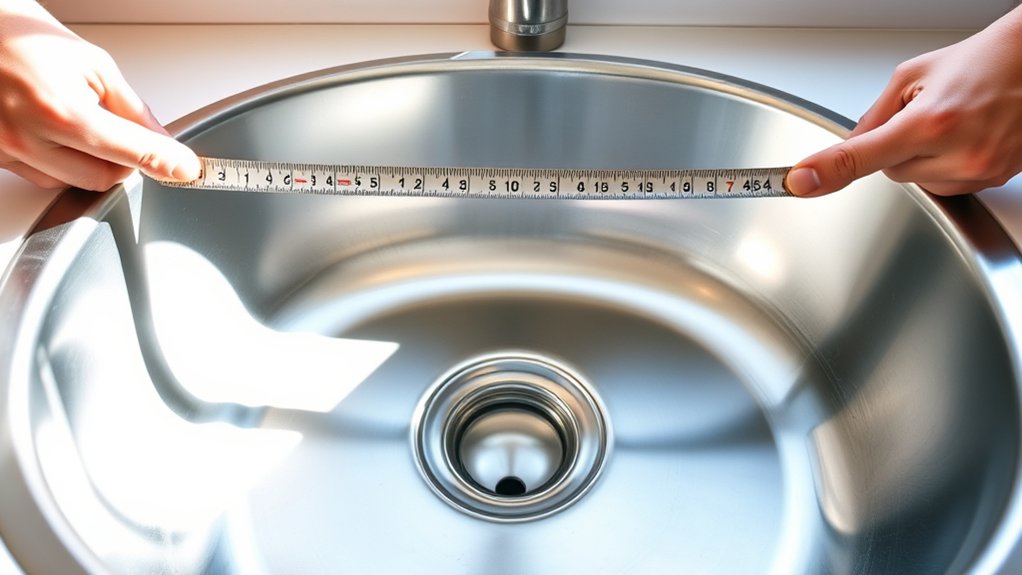
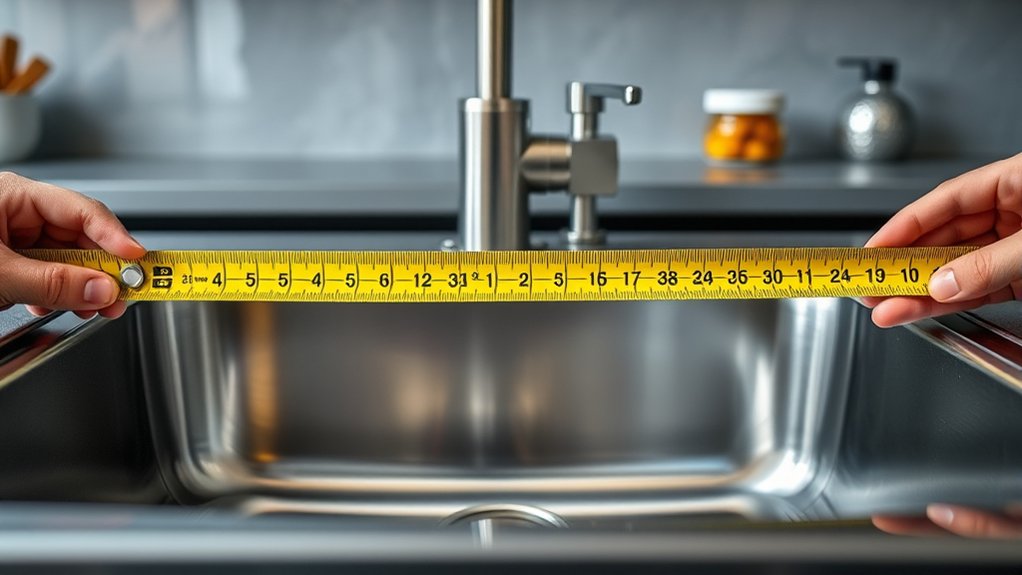
Start by placing your tape measure or ruler along the outer edge of the sink to find its length, running from one end to the other. Then, measure the width by placing the tape across the widest part of the sink’s outer rim. Be sure to record these measurements accurately for fitting accessories or replacements.
To make your measurements more accurate, consider these tips:
- Record the faucet height from the bottom of the sink to the highest point of the faucet to ensure proper clearance.
- Measure the drain diameter at the outer edge to confirm it will fit with your drain fittings.
- Double-check your measurements to ensure consistency, especially if you’re buying custom fixtures or accessories.
Getting the outer length and width right, along with faucet height and drain diameter, helps make sure your sink replacements or upgrades fit perfectly without surprises.
Determine the Depth and Interior Bowl Size
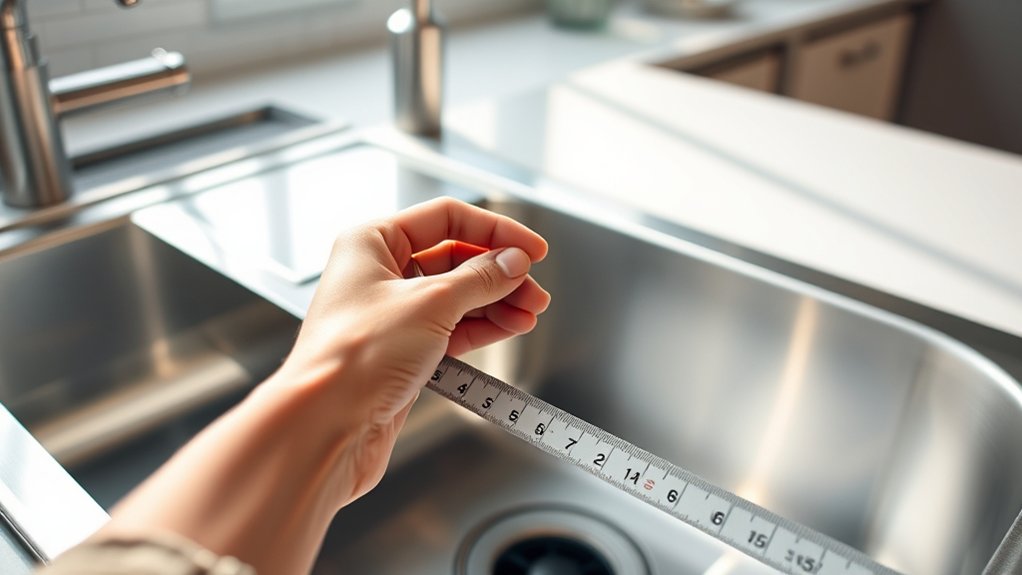
Measuring the depth and interior bowl size of your sink is key to making sure it fits your needs and space. Use a tape measure to find the distance from the top edge to the bottom of the bowl, and note the measurement in inches.
Next, measure the width and length inside the bowl at the widest points to get the interior size. Material choices like stainless steel, porcelain, or composite can affect how deep your sink can be without losing durability.
If you’re replacing an existing sink, double-check that your new measurements match the current cutout and mounting requirements. Accurate measurements help you pick a sink that’s comfortable to use and can handle your daily tasks.
Taking these steps ensures your new sink fits perfectly, both in function and style.
Double-Check and Record Your Measurements
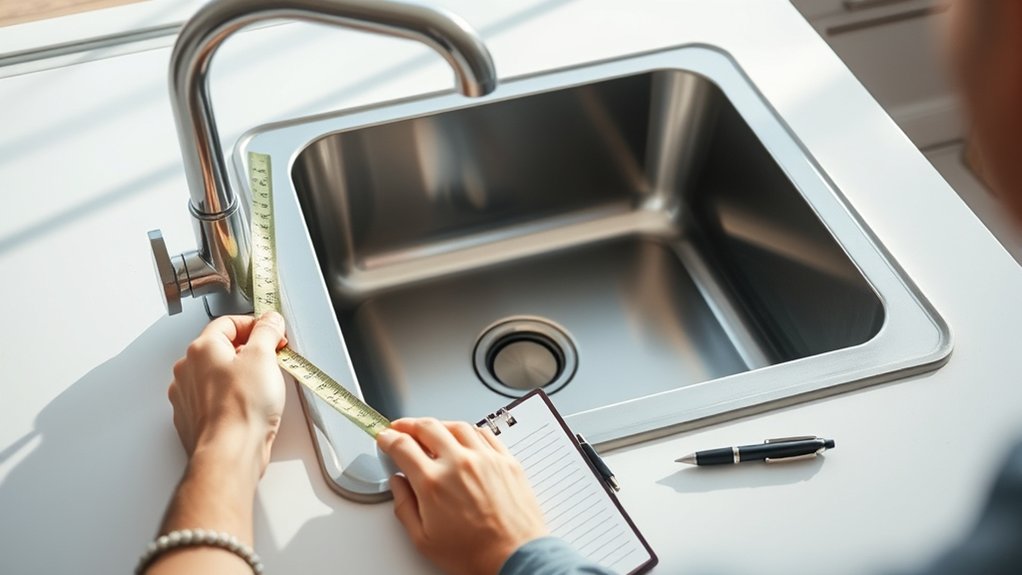
Before moving forward, double-check all your measurements to guarantee accuracy. Precise measurements ensure your sink fits perfectly and take into account material considerations like countertop thickness and mounting style. To avoid mistakes, verify each dimension twice and record them carefully.
Here are some key steps to follow:
- Re-measure the length, width, and depth, comparing with your initial readings for consistency.
- Clearly note down your measurements, including any notes on material considerations like edge clearance or mounting space.
- Review installation tips, making sure your measurements match the sink’s specifications and your cabinet dimensions.
Recording your measurements carefully helps prevent errors during installation and ensures your sink complements your kitchen layout. Double-checking guarantees all measurements are accurate, reducing the risk of costly adjustments later.
This careful approach simplifies the installation process and helps you achieve a seamless fit.
Frequently Asked Questions
How Do I Measure Irregular or Non-Standard Sink Shapes?
To measure irregular or non-standard sink shapes, start by measuring the widest and deepest points to get the overall dimensions. Use a flexible measuring tape to follow the contours, capturing the shape accurately.
Record multiple measurements across different sections, then sketch a diagram to visualize the shape. This way, you make sure you account for irregular shapes and non-standard sizes, helping you find the right fit for replacements or accessories.
What Are the Common Mistakes to Avoid When Measuring?
To ensure your measurements are accurate, avoid common mistakes like using a loose tape measure or measuring from the wrong points.
Make sure to keep the tape level and straight because angles can throw off your readings.
It’s a good idea to measure a few times to check for consistency.
Skipping these steps can lead to errors that might cause fittings or replacements to be off.
Stay precise by double-checking your measurements and take your time.
Can I Use a Smartphone App to Measure My Sink?
Yes, you can use a smartphone app to measure your sink, but make sure to calibrate the app properly for accurate results.
Check if the app offers smartphone calibration features and select your preferred measurement units, like inches or centimeters.
Keep your phone steady while measuring to get precise results. Remember, some apps might be less accurate than traditional tools, so double-check measurements if precision is important.
How Do I Measure for Sink Accessories or Custom Fittings?
Think of measuring sink accessories like fitting pieces of a puzzle; accuracy is crucial. Start by carefully measuring your sink’s dimensions, including depth, width, and length.
Next, check the faucet placement to make sure accessories won’t get in the way. Use a flexible measuring tape for better accuracy and double-check your measurements.
Getting precise measurements helps your custom fittings fit perfectly, just like fitting the last puzzle piece smoothly. This prevents leaks or obstructions, making everything work seamlessly.
What Is the Best Way to Store My Measurements for Future Use?
To store your measurements for future use, focus on measurement storage and organization. Write them down neatly in a dedicated notebook or create a digital file on your device.
Use clear labels and categories for easy reference, like sink dimensions or accessory sizes. Regularly update your records whenever you take new measurements.
This organized approach guarantees you can quickly find what you need, saving time and avoiding errors in future projects.
Conclusion
So, now you’re a sink measurement pro—who knew it’d be so straightforward? You’ve mastered measuring, avoided costly mistakes, and saved time.
Ironically, the biggest challenge might be resisting the urge to buy that fancy new faucet or sink before double-checking those numbers.
But hey, with your newfound skills, you’re all set to make your kitchen upgrade smooth, precise, and more satisfying.
Happy measuring with your kitchen sink!