Mastering Your Corner Kitchen Cabinet Organization
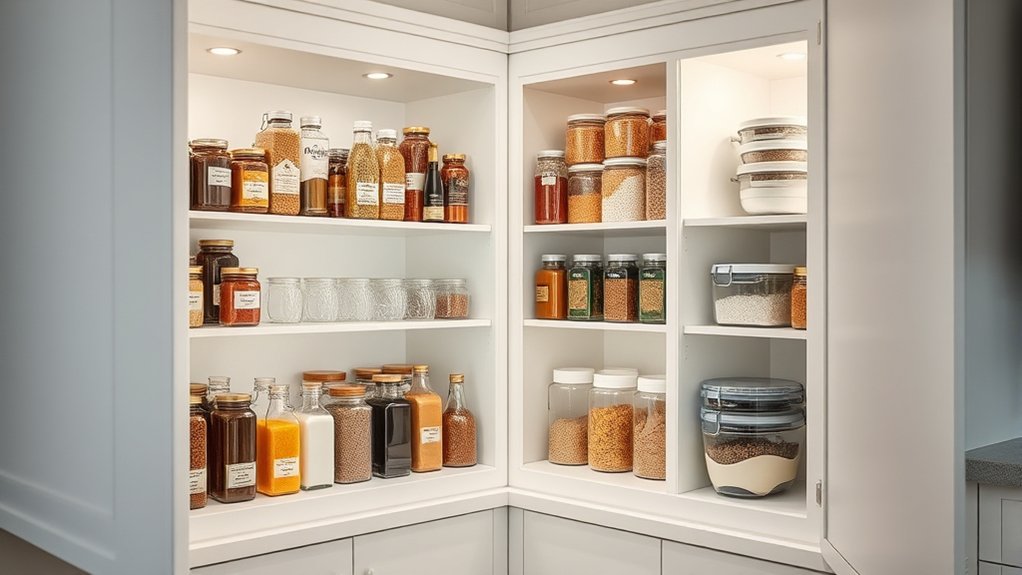
Nearly every kitchen has one: a cabinet tucked into the corner where two runs of counters meet, deep enough to swallow a stockpot whole and shaped in a way that makes half of it feel permanently out of reach. Corner cabinets exist because kitchen layouts have to turn a corner somewhere, and rather than waste that space entirely, cabinet makers build a box around it.
The result is more storage volume than almost any other cabinet in the kitchen, but also the hardest one to actually use well. This guide walks through why corner cabinets are so troublesome, how to figure out what kind you have, and the specific systems, products, and habits that turn that dead zone into one of the most functional spots in your kitchen.
Why Corner Cabinets Are So Hard to Organize
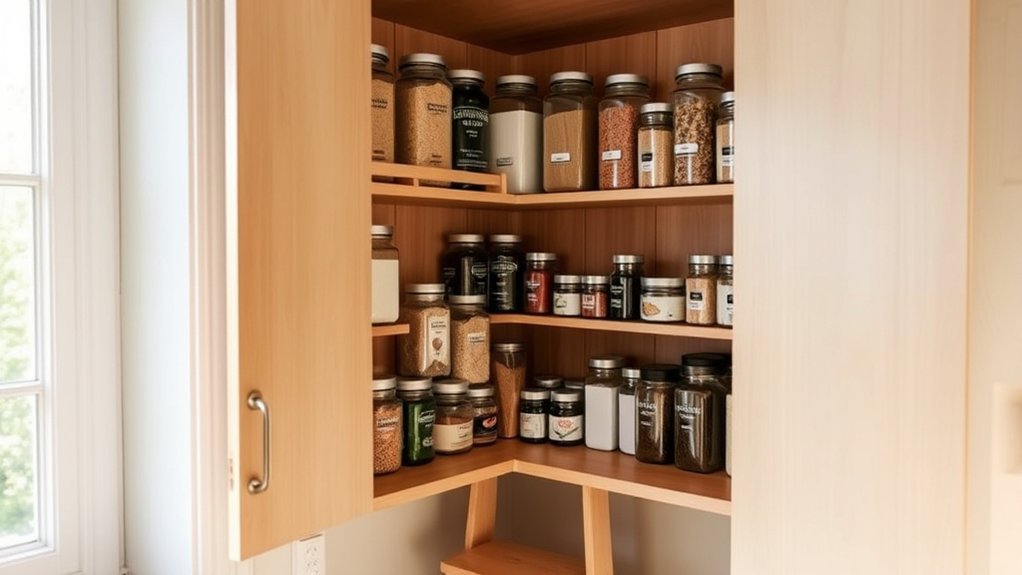
The trouble with a corner cabinet comes down to geometry. A standard cabinet is a simple rectangular box: open the door and everything inside is visible and within arm’s reach. A corner cabinet is not a simple box. Because two cabinet runs meet at a ninety-degree angle, the interior either wraps around a hidden pocket of space behind the neighboring cabinet’s wall, or it takes on a diagonal, pie-slice, or L-shape that a standard shelf can’t fill efficiently.
Depending on the era and builder of your kitchen, you’ll typically encounter one of a few configurations: a diagonal cabinet with an angled door and a lazy Susan or rotating shelf system inside, a blind corner cabinet where one full cabinet run tucks in behind the other and part of the interior sits completely out of view behind the adjoining cabinet wall, or, less commonly, a fully custom diagonal or curved cabinet built for a specific kitchen layout.
Whatever the configuration, the underlying problem is the same: the back of the cabinet is far from the door opening, poorly lit, and awkward to reach without kneeling or crawling. Left unaddressed, corner cabinets tend to become a catch-all for items that don’t have another home, which only makes the reach-and-dig problem worse over time.
Step One: Declutter Before You Organize
It’s tempting to jump straight to buying a Lazy Susan or a pull-out organizer, but any storage system works better with less inside, and a corner cabinet in particular has no room to spare for things you don’t actually use. Before you touch a single organizer product, take everything out of the cabinet completely. Set it all out on the counter or table where you can see it clearly, rather than sorting item by item while still reaching into the cabinet.
With everything out, sort it into simple categories: keep, donate or sell, and discard. Duplicate pans, warped bakeware, lids without a matching pot, and small appliances you haven’t used in the last year are the classic culprits that quietly eat up corner cabinet space. While the cabinet is empty, wipe down the shelves and check that the shelf pegs or Lazy Susan hardware are in good working order — this is also the easiest time to address any liners, contact paper, or minor repairs before everything goes back in.
Once you’re down to only what you’ll actually keep, decide on a single, specific purpose for the cabinet before you put anything back. A corner cabinet that’s designated purely for cookware, or purely for baking supplies, or purely for pantry overflow, stays organized far longer than one that becomes a miscellaneous catch-all. Mixing categories is one of the fastest ways for a freshly organized corner cabinet to slide back into chaos.
Step Two: Identify Your Cabinet Type
The right organizing system depends heavily on the type of corner cabinet you have, so it’s worth taking a moment to look closely at the hardware before you shop for organizers.
Lazy Susan (Diagonal) Cabinets
If your cabinet has a single diagonal door and, when you open it, you see one or more circular or kidney-shaped shelves that spin, you have a lazy Susan cabinet. These are the most common configurations in older and mid-range kitchens. The shelves rotate independently or together around a central pole, letting you spin items into view instead of reaching to the back.
Blind Corner Cabinets
If your cabinet has a standard rectangular door but you can tell — by measuring or by feeling around inside — that the cabinet box extends well beyond what the door opening reveals, you have a blind corner cabinet. Roughly half of the interior sits hidden behind the wall of the adjacent cabinet, accessible only by reaching in sideways. This is widely considered the single most awkward storage configuration in a typical kitchen, since even kneeling down often isn’t enough to see or reach the far corner.
Custom Diagonal or Angled Cabinets
Higher-end or custom kitchens sometimes use a cabinet built specifically for the corner, with an angled face and shelving cut to match. These offer good visibility but are less common and usually not retrofit candidates, since the cabinet box is shaped differently from that of a standard unit.
Organizing a Lazy Susan Corner Cabinet
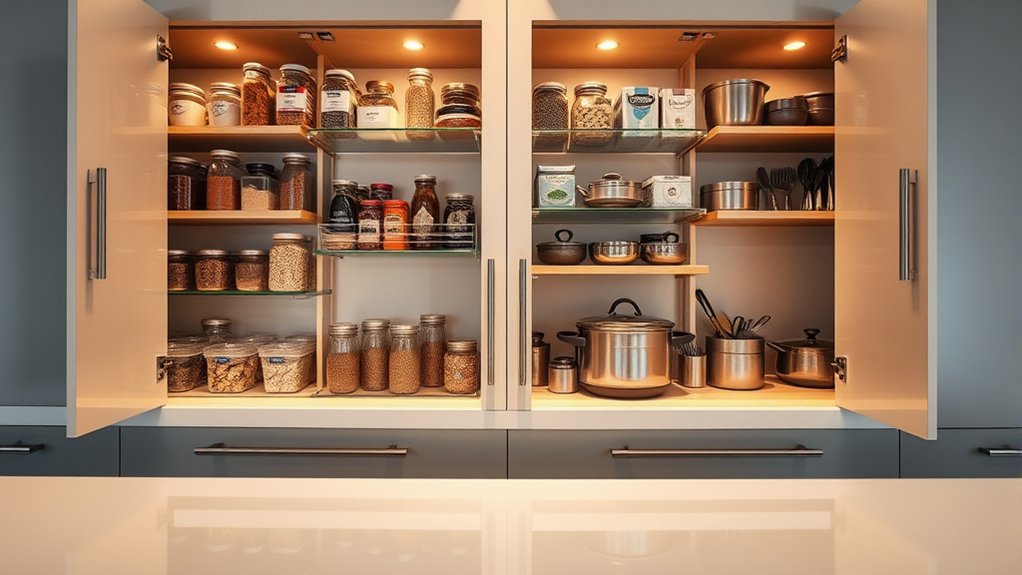
If you already have a functioning lazy Susan, the biggest improvement usually comes from being deliberate about how items are arranged on the rotating shelves rather than replacing the hardware. Because the shelf is circular, items placed in a wedge or pie-slice pattern — wide end toward the outer edge, narrow end toward the center pole — use the space far more efficiently than items lined up in straight rows.
This matters especially for pots and pans: position the pot or pan body toward the outer rim, with the handle pointing inward toward the center. This keeps handles from catching on the cabinet walls as the shelf spins and lets you fit noticeably more cookware around the circumference than a side-by-side arrangement would allow.
For smaller items like spices, canned goods, or condiments, wedge-shaped bins designed to match the pie-slice geometry of the shelf keep small jars from tipping over or sliding into the gaps near the center pole as the tray rotates. A second, smaller turntable set inside a large lazy Susan shelf can also help corral small items like spice jars into their own zone rather than letting them scatter across the full rotating surface.
If your cabinet doesn’t have a built-in Lazy Susan but has the depth for one, retrofitting an aftermarket turntable is usually straightforward and inexpensive. Full-circle turntables work well in diagonal cabinets with open access to the entire circle, while D-shaped, kidney-shaped, or half-moon turntables are designed for cabinets where part of the circle is blocked by a cabinet wall or the door frame.
Measure the interior diameter and height clearance of your cabinet before buying, since lazy Susans come in a range of sizes and won’t function well if they’re too large for the space or too tall to clear the shelf above.
Organizing a Blind Corner Cabinet
Blind corner cabinets benefit most from dedicated hardware because no amount of clever bin placement can solve the fundamental problem of a hidden, hard-to-reach pocket of space. Two main categories of product address this: pull-out systems and swing-out systems, often marketed under names like “magic corner” or similar branded terms.
Pull-Out and Swing-Out Organizers
These systems mount inside the cabinet and typically consist of two sets of wire or metal baskets. When you open the door and pull the handle, a front set of baskets glides forward and to the side, while a rear set — the part previously hidden behind the adjacent cabinet wall — swings or slides out into full view at the same time.
The effect is that everything in the cabinet becomes visible and reachable in a single motion, without kneeling or reaching blindly into the dark. Most of these systems support fairly heavy loads, ranging from fifteen to twenty-five pounds per basket, which is enough for stacked pots, cast-iron cookware, or small appliances.
They’re sold to fit specific minimum door-opening widths, so measuring your cabinet opening precisely before ordering is essential — a unit that’s too large for the opening won’t operate correctly.
Simpler, Lower-Cost Options
If a full pull-out system isn’t in the budget or isn’t compatible with your cabinet’s construction, a half-moon or kidney-shaped shelf mounted on a swing hinge is a lower-cost alternative that still brings the back portion of the cabinet within reach, even if it doesn’t fully solve the hidden-pocket problem the way a full pull-out system does.
Simply adding baskets, bins, or a small step shelf near the front of a blind corner cabinet, combined with a strict rule about which items live toward the back, can also meaningfully reduce the frustration even without new hardware — reserve the inaccessible rear zone for items you use only occasionally, such as holiday cookware or an appliance you reach for a few times a year.
Storing Pots, Pans, and Lids in a Lower Corner Cabinet
Lower corner cabinets are the default home for cookware in most kitchens, and cookware is uniquely awkward to store well: pieces are heavy, irregularly shaped, and easily scratched if stacked carelessly. A few approaches consistently work better than simply stacking pots flat on a single shelf.
- Vertical dividers or a slotted pan rack let you store pans standing on edge rather than stacked, so each one can be pulled out individually without unstacking the whole pile — this also roughly doubles the number of pans you can fit in the same footprint compared with flat stacking.
- A tension rod mounted low and horizontal inside the cabinet gives lids a place to lean vertically, sorted loosely by size, which is more flexible than a fixed-slot lid rack when your lid sizes don’t match evenly.
- Felt or foam pads between stacked pieces protect nonstick and enamel coatings from scratching where stacking is unavoidable.
- If the cabinet has a lazy Susan, use the pie-slice arrangement described earlier — handles toward the center, bodies toward the rim.
Before adding any of these products, it’s worth genuinely thinning out your cookware collection. A common pattern is owning two overlapping sets accumulated over the years — a slightly worn set that never quite got replaced when a newer set arrived. Every pan you remove from the rotation makes the remaining pieces easier to store and access, which matters more in a corner cabinet than in almost any other part of the kitchen.
Organizing an Upper Corner Cabinet
Upper corner cabinets present a different challenge: they’re often deep from front to back but shallow in usable height, and reaching to the back means standing on a step stool while trying to see into a dim, narrow space. A few strategies work particularly well here.
Small turntables — generally in the ten-to-fifteen-inch range — are ideal for mugs, spice jars, or small condiment bottles, since a smaller tray avoids the dead zone that a larger lazy Susan leaves near its own center. Because upper corner cabinets are often unusually deep in the middle but narrow along the sides, a long, narrow bin or tray positioned front-to-back through the center of the cabinet can make good use of that dimension — for example, holding blender attachments or measuring tools, with adjacent narrow shelf space used for taller bottles on either side.
It’s also worth rethinking what actually belongs in an upper-corner cabinet, rather than assuming it has to hold dinnerware or everyday dishes. Because reaching the back is inherently more effort, this cabinet is often better suited to items used somewhat less frequently, or to a self-contained “station” — a coffee and tea station with mugs and a small appliance, or a smoothie station with protein powders and a blender, all grouped in one place so the whole cabinet has one clear job.
Finally, don’t skip adjusting the shelf height. Many upper cabinets ship with shelves spaced for average dinnerware, which wastes significant vertical space if you’re storing shorter items like spice jars or mugs — lowering a shelf to match the height of what’s actually stored there can meaningfully increase capacity.
Choosing Bins, Baskets, and Containers
Whichever cabinet type you’re working with, the containers you use inside it matter almost as much as the shelving hardware itself. A few general principles apply across nearly every corner cabinet configuration:
- Measure before buying. Corner cabinets have unusual dimensions, and a bin that looks like a good fit in a product photo may not clear the door swing, the center pole of a lazy Susan, or the shelf above.
- Clear or transparent bins make it far easier to find things by sight rather than by feel, which matters most in the darker recesses of a corner cabinet.
- Wedge- or pie-shaped containers are worth the extra cost, especially for Lazy Susan shelves, since rectangular bins waste the triangular space near the shelf’s edge.
- Stick to one designated category per bin — spices in one, canned goods in another — rather than mixed miscellaneous bins, which tend to become the cabinet’s next clutter problem.
It’s generally not necessary to buy the most expensive soft-close, branded hardware to get a well-organized corner cabinet. Budget turntables and wire baskets from general retailers perform nearly as well as premium branded systems for most households; the premium systems mainly add smoother movement, higher weight capacity, and longer warranty coverage, which matter more in a high-use kitchen than in an average household kitchen.
Maintaining the System Over Time
Every organizing system, no matter how well designed, degrades over time unless it’s paired with a habit of putting things back correctly. A few maintenance habits go a long way toward keeping a corner cabinet functional for years, not months.
Do a quick check-in every few months rather than waiting for a full annual overhaul — pull everything forward, confirm nothing has drifted out of its designated zone, and remove anything new that’s snuck in without a clear category. Whenever you buy a replacement pot, appliance, or container, get rid of the item it replaces at the same time, rather than letting both the old and new versions take up space.
And if you notice the same item consistently ending up in the wrong spot, treat that as a signal that its assigned home isn’t actually convenient, rather than a personal failure to put things away correctly — sometimes the fix is simply moving that item to a more logical cabinet.
Common Mistakes to Avoid
- Buying an organizer before decluttering — a lazy Susan or pull-out system will always underperform if it’s loaded with items you don’t actually use.
- Skipping measurements — corner cabinet hardware is sold to fit specific minimum openings and depths, and a poor fit can prevent the mechanism from working at all.
- Mixing unrelated categories in one cabinet makes it hard to remember where anything lives and speeds up re-cluttering.
- Stacking pots and pans flat without dividers wastes vertical space and makes it hard to remove one piece without unstacking several others.
- Ignoring the very back of a blind corner cabinet rather than either fitting it with a pull-out system or deliberately assigning it to rarely used items.
- Leaving shelf height at the factory default instead of adjusting it to match what’s actually being stored.
Frequently Asked Questions
Do I need a lazy Susan, or can I just use regular shelves?
Regular flat shelves work fine near the front of a corner cabinet, but the deeper the cabinet, the more a rotating shelf pays off. If your cabinet is a diagonal cabinet with real depth behind the door, a lazy Susan is generally worth adding; if it’s a shallower cabinet where everything is already within easy reach, you may not need one.
How much does it cost to add a pull-out or lazy Susan system?
Costs vary widely by system and brand. A basic aftermarket turntable is typically among the least expensive kitchen organizing products available, while a full soft-close pull-out or swing-out system for a blind corner cabinet costs considerably more because it involves more hardware and a more complex mechanism. Between those two extremes, wire baskets, roll-out trays, and simpler swing-out shelves offer a mid-range option.
Can I install a corner cabinet organizer myself, or do I need a professional?
Freestanding turntables that simply sit on an existing shelf require no installation. Aftermarket lazy Susans that mount to the cabinet floor and basic roll-out trays are generally considered DIY-friendly projects for someone comfortable with basic tools.
Full pull-out or swing-out systems for blind corners require more precise mounting and alignment, so while some people install them themselves, many choose to have a professional or experienced handyperson handle the installation to ensure the mechanism operates smoothly.
What’s the difference between a lazy Susan cabinet and a blind corner cabinet?
A lazy Susan cabinet has a single angled or diagonal door, and everything inside is visible once the door opens, arranged on one or more rotating shelves. A blind corner cabinet has a standard rectangular door, but a significant portion of the cabinet interior — often close to half — sits hidden behind the wall of the neighboring cabinet, accessible only by reaching in sideways rather than by opening the door and looking straight in.
What should I avoid storing in a corner cabinet?
Very large or bulky items like stockpots, slow cookers, and air fryers are often poor fits for corner cabinets, since their size makes them hard to maneuver in and out of the cabinet’s irregular shape, especially in a blind corner.
These tend to work better in a standard rectangular cabinet where they can be lifted straight out. It’s also worth keeping hazardous items like cleaning chemicals separate from a food-storage corner cabinet and storing them in their own secure spot.
How often should I reorganize a corner cabinet?
A full decluttering and reset once a year is a reasonable baseline for most households, but a quick check-in every few months — pulling items forward, confirming everything is still in its assigned zone, and removing anything that doesn’t belong — goes a long way toward preventing the cabinet from sliding back into clutter between those bigger resets.
Will a corner cabinet organizer work in any kitchen, or do I need to check measurements first?
Always measure first. Corner cabinet hardware — whether a lazy Susan, a roll-out tray, or a full pull-out system — is manufactured to fit specific minimum door-opening widths, depths, and interior heights. A unit that’s the wrong size for your cabinet may not fit at all, or may not operate smoothly even if it technically fits, so measuring the door opening and interior dimensions before buying is essential, regardless of which type of organizer you choose.
Bringing It Together
A corner kitchen cabinet will probably never be as effortless to use as a simple rectangular cabinet, but it doesn’t have to stay the dreaded, cluttered dead zone it often becomes. Start by clearing it out completely and deciding on one clear purpose for the space. Identify whether you’re working with a lazy Susan, a blind corner, or a custom diagonal cabinet, since that determines which hardware will actually help.
From there, match the storage method to what you’re keeping — pie-slice arrangements and wedge bins for rotating shelves, a pull-out or swing-out system for blind corners, vertical dividers for cookware, and right-sized turntables or long, narrow trays for upper cabinets. When combined with a light maintenance routine every few months, these changes turn one of the kitchen’s most frustrating cabinets into one of its most efficient.